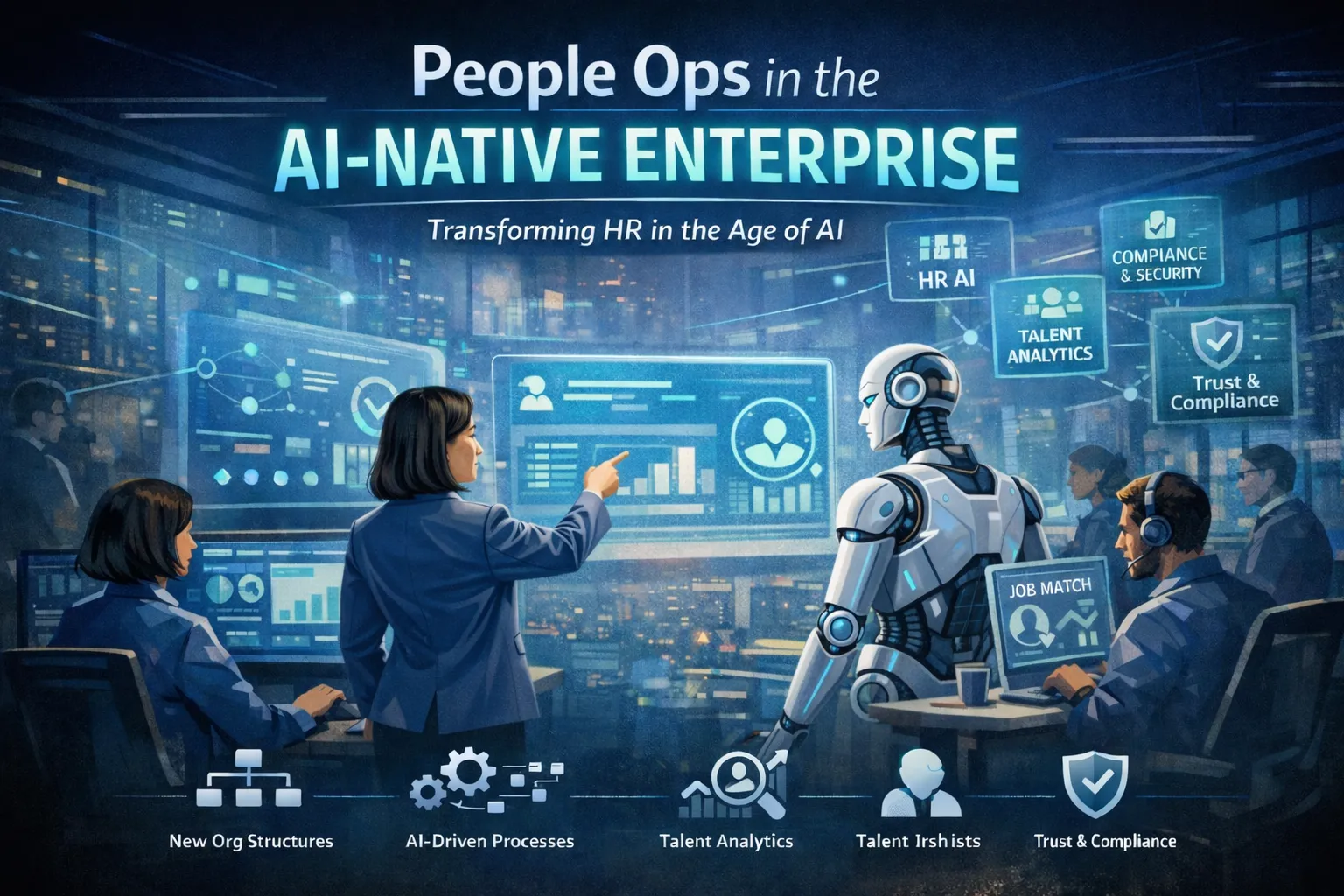
People Ops in the AI-Native Enterprise
Transforming HR in the Age of AI
Tech enterprises that truly adopt AI don’t just ship faster — they operate differently.
Product changes. Engineering changes. Support changes. Finance changes.
And People Operations changes fundamentally.
When AI becomes part of the production system — not just a side tool — People Ops stops being a service center and becomes an operating system.
The Big Shift
In an AI-native organization:
- Work is increasingly mediated by AI agents.
- Artifact volume explodes (docs, experiments, summaries, insights).
- Decision velocity increases.
- Risk scales faster than before.
People Ops becomes responsible for ensuring the productivity upside does not destroy trust, fairness, or compliance.
From Programs to Systems
Traditional People Ops is organized around programs:
- Recruiting
- Performance
- Learning
- Compensation
- HRBP support
AI-native People Ops is organized around systems:
- Decision systems (promotion, comp, performance)
- Talent systems (hire → onboard → grow → redeploy)
- Capability systems (skills, learning, workforce planning)
- Work systems (how work flows across teams)
- Trust systems (governance, auditability, fairness)
Org Structure in the AI-Native Enterprise
1. People Product & AI
A new core function emerges.
Owns:
- Employee-facing AI assistants
- Workflow automation
- Policy knowledge systems
- Vendor AI tooling strategy
- Data contracts with Security & Legal
New roles:
- People Product Manager
- People Ops Architect
- HR Data & AI Analyst
- Prompt/Policy Designer
- AI Change Management Lead
2. Workforce Intelligence (formerly People Analytics)
Moves from dashboards to strategic leverage:
- Org network analysis
- Skills inference
- Workforce planning simulations
- AI adoption measurement
- Bias monitoring at scale
3. HRBPs Become Org Designers
HRBPs shift focus toward:
- Team topology
- Role clarity
- Decision quality
- Manager capability
- Career architecture redesign
AI changes leverage — HR must redesign roles accordingly.
4. Talent Acquisition → Assessment Engineering
Sourcing becomes automated.
Evaluation becomes the differentiator.
New capabilities:
- Structured evaluation systems
- Job simulations
- AI-use transparency policies
- Continuous bias auditing
5. Learning & Development → Capability Engineering
From content delivery to capability measurement.
- Skills graphs
- Personalized development loops
- Practice simulations
- AI collaboration literacy
Process Changes Across the Lifecycle
Hiring
AI accelerates sourcing and screening.
What matters now:
- Structured rubrics
- Work-sample evaluations
- Transparency about AI usage
- Continuous bias detection
Failure mode: opaque screening systems.
Onboarding
Becomes dynamic and contextual.
AI-native onboarding includes:
- Role-aware onboarding copilots
- Automated 30/60/90 plans
- Least-privilege provisioning
Failure mode: data leakage via helpful assistants.
Performance Management
Shifts from episodic reviews to continuous signals.
Upgrades:
- Evidence-linked feedback
- AI-assisted summaries (manager-owned)
- Calibration supported by analytics
- Clear human accountability
Failure mode: surveillance culture.
Promotions & Career Ladders
AI expands individual leverage.
Career ladders must include:
- Judgment
- Systems thinking
- Quality bar stewardship
- AI collaboration capability
Failure mode: rewarding output volume over impact.
Compensation
AI increases skill volatility and productivity variance.
People Ops must:
- Redefine role boundaries
- Update leveling frameworks
- Tighten internal equity review
Failure mode: comp decisions detached from evolving roles.
Internal Mobility & Workforce Planning
AI enables proactive redeployment.
Modern systems include:
- Internal gig marketplaces
- Skills inference (privacy-preserving)
- Structured reskilling paths
Failure mode: “reskilling” without real internal demand.
Tooling in the AI-Native People Stack
HRIS Is No Longer the Center
HRIS becomes system of record.
The new center of gravity:
- Workflow orchestration
- Policy retrieval systems
- Analytics engines
- Identity & access governance
- Skills infrastructure
The People Copilot Pattern
A unified interface that can:
- Answer policy questions (with citations)
- Draft documents
- Trigger workflows
- Route cases
- Provide contextual guidance
Non-negotiables:
- Permissions enforcement
- Audit logs
- Source transparency
- Human-in-the-loop escalation
Governance & Trust
AI must never become a hidden decision-maker.
Any AI influencing:
- Hiring
- Performance
- Promotion
- Termination
- Compensation
Must have:
- Documented decision path
- Clear accountability
- Audit trail
- Appeal mechanism
Trust beats novelty.
New Operating Rhythms
Quarterly
- Workforce strategy review
- Role evolution mapping
- AI adoption impact analysis
- Manager effectiveness review
Monthly
- Promotion pipeline check
- Bias sanity checks
- Mobility metrics
- Calibration-lite sessions
Weekly
- People Ops incident review
- Policy errors
- Data leakage review
- Automation failure analysis
Treat workflow mistakes like production incidents.
Metrics That Matter
Better signals:
- Time-to-productivity
- Internal mobility rate
- Manager effectiveness
- Decision cycle time
- AI adoption quality impact
Metrics to avoid drifting into:
- Employee activity inference
- Productivity surveillance
- “Hours saved” obsession
Trust is the multiplier.
A Pragmatic Rollout Path
Phase 1 — Safe Automation (0–60 days)
- Case triage automation
- Policy Q&A (read-only)
- Document drafting with approvals
Phase 2 — Manager Leverage (60–120 days)
- AI-assisted summaries
- Review drafting support
- Internal mobility suggestions
Phase 3 — Org Intelligence (120–240 days)
- Skills graph v1
- Workforce planning simulations
- Intervention experimentation
Phase 4 — The New Operating System
- Integrated People Copilot
- Continuous calibration
- Mature governance
- High-trust AI deployment
The Real Transformation
AI does not replace People Ops.
It upgrades it.
People Ops becomes:
- A systems designer
- A trust architect
- A workforce strategist
- A governance operator
- A capability engineer
In the AI-native enterprise, productivity scales.
Risk scales.
Opportunity scales.
People Ops ensures culture, fairness, and human dignity scale too.
Final Thought
The AI-native enterprise is not about replacing humans.
It is about redesigning the operating system of work.
And People Ops is at the center of that redesign.