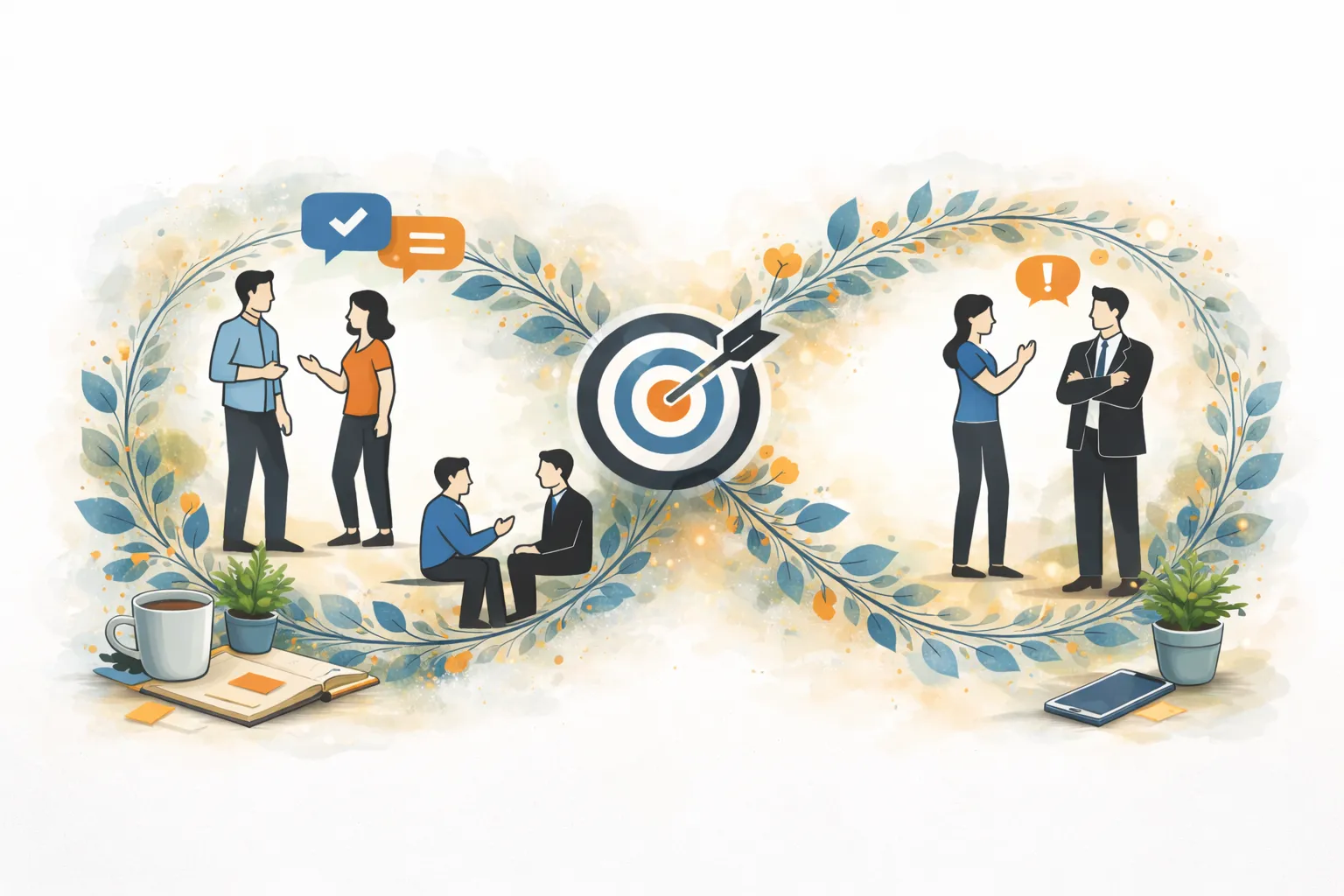
When I started this blog, I knew I would write about growth. About how we evolve at work and in life. Feedback sits at the center of that evolution.
In organizations, feedback culture is one of the most discussed and least realized ambitions. It appears in strategy decks, leadership offsites, engagement surveys. It sounds progressive. Mature. Necessary.
And it is necessary.
Yet in many companies, years pass and very little actually changes.
The Bottleneck Nobody Talks About
Most organizations approach feedback culture through a single door: managers.
They invest in training managers how to give effective feedback. They design toolkits. They build frameworks. They run workshops. All of this matters. Managers absolutely need skill, clarity, and structure.
But here is where many companies get stuck.
They treat feedback culture as a manager capability project.
And they stay there.
They refine the model. They relaunch the training. They introduce new terminology. Meanwhile, the day to day behavior does not shift.
In reality, building feedback as a habit is often a two year journey when approached intentionally.
Year one is about consistency. Nudges. Embedding feedback into performance processes. Making it normal. Visible. Expected.
Year two is about flexing the muscle. Improving quality. Moving from transactional comments to developmental conversations.
Instead, many organizations keep redesigning manager training year after year.
The muscle never builds because the system never evolves beyond one side of the equation.
What Is Missing: The Second Half of the System
There are actually two blind spots.
The first is employee enablement.
The second is manager vulnerability.
Let me start with employees.
Feedback culture is not only about equipping managers. It is about enabling employees from the very beginning.
Employees need to learn:
- How to ask for feedback intentionally
- How to receive feedback without defensiveness
- How to provide developmental feedback to peers
- And eventually, how to give thoughtful feedback upward
Most companies underestimate the power of peer feedback.
Manager feedback is critical. But peer feedback is transformational.
When an employee feels comfortable giving constructive feedback to a colleague, something shifts. They are no longer passive recipients of evaluation. They become contributors to growth. They practice observation. They learn to articulate impact. They build courage.
Peer feedback is often the safest starting point. It builds language. It builds confidence.
Then comes asking for feedback. Not casually, but intentionally. Not “any thoughts?” but “what is one thing I could have done differently in that meeting to be more effective?”
Learning to ask well changes the dynamic. It signals ownership.
But here is where many systems still fall short.
Even if employees learn how to provide upward feedback, what happens if managers are not prepared to receive it?
The Overlooked Skill: Managers Asking and Receiving
We often teach managers how to give feedback.
We rarely teach them how to ask for it.
And almost never how to react to it, if it comes from someone in their team.
This is where the real shift happens.
If employees are encouraged to provide upward feedback, but managers do not know how to invite it, listen to it, and respond without defensiveness, the system collapses.
Manager growth must include:
- How to explicitly ask their team for feedback
- How to create safety in the moment
- How to respond with curiosity rather than justification
- How to demonstrate visible behavior change
When a manager says, “What is one thing I could do differently to support you better?” and genuinely listens, something powerful occurs.
The hierarchy softens.
Trust increases.
And employees begin to believe that feedback is not a performance ritual, but a shared responsibility.
This is when feedback stops flowing in one direction.
It becomes a two way road.
Employees learn how to provide upward feedback with skill and respect.
Managers learn not only to receive it, but to give it with clarity and to ask for it with humility.
And instead of standing on opposite sides of a power dynamic, they begin moving toward each other.
Why This Changes Everything
Very few organizations can genuinely say that employees both know how to give constructive feedback to their managers and feel psychologically safe doing so.
Even fewer can say that managers actively and consistently ask for it.
But when both capabilities develop in parallel, the culture accelerates.
If companies train employees properly, they are already halfway there.
If they train managers not only to give feedback but to seek it and respond to it well, they complete the loop.
Because culture does not shift all at once. It shifts when a few people behave differently.
Someone gives thoughtful feedback to a peer. Someone asks for input after a presentation. A manager openly thanks a team member for constructive upward feedback and makes a visible change.
If that behavior is not punished or dismissed, something subtle begins to move.
That is when the shift starts.
That is when the magic begins.
Feedback culture is not a slogan. It is not a workshop. It is not a model printed on a slide.
It is a distributed capability built on two parallel tracks:
Employees learning to give. Managers learning to receive and to give. Both learning to ask.
When they move toward each other, feedback stops being an event.
It becomes the engine behind individual and team development.